
%20(1).png)


Mulberry Leaves: The Tree of Life
Ancient Lore, Sacred Legend & Modern Science
A Leaf That Built Civilizations
There is a single leaf that clothed emperors, launched trade routes spanning thousands of miles, inspired two of the most enduring love stories in world literature, was declared immortality medicine by ancient Chinese physicians, and is now being studied as a natural treatment for type 2 diabetes. That leaf belongs to the mulberry tree — Morus alba, the white mulberry — and it has been at the center of human civilization in ways so fundamental that its absence is almost impossible to imagine.
The history of man utilizing the mulberry leaf for its unique healing properties dates back over 5,000 years. Commonly known as the food source for silkworms, the mulberry leaf is considered one of the oldest herbs used by man. The mulberry tree was central to life in ancient times, both in the East and West. It has been used throughout Asia, Europe, the Middle East, and India as a healing food ingredient and as a traditional medicine to restore health.
Described in legends dating thousands of years in Chinese mythology, the mulberry tree is considered "The Tree of Life" and "The Herb of Immortality." China's oldest book of remedies — the bible for all herbal medicine — refers to the dry mulberry leaf tea, sang ye cha, or "godly hermits' tea," as a miracle remedy, an immortality medicine.
From the shelves of Shen Nong's Bencao Jing to the Silk Road that its leaves made possible, from Ovid's Metamorphosesto clinical trials in 2024, the mulberry leaf has never stopped mattering. What science is only now quantifying — its extraordinary effect on blood sugar, its anti-inflammatory reach, its neuroprotective potential — is what the physicians of the Tang Dynasty called sang ye and prescribed without hesitation. The leaf knew what it was doing long before we understood the mechanism.
Names Across Worlds
The mulberry's names form a linguistic atlas of the civilizations
that valued it. In Chinese it is sang (桑) — a character so
ancient it appears in oracle bone inscriptions — and its leaves are sang ye (桑葉). The fruit is sang shen, the root bark is sang bai pi. In Japanese it is kuwa, its leaves central to the sericulture tradition that shaped Japanese culture for two thousand years. In Persian it is toot or shahtoot — the royal mulberry — in Arabic toot as well, carrying the same root across the Islamic world. In Ayurvedic Sanskrit it is shahtut. In Italian it is gelso, in Spanish morera, in French mûrier, in Turkish dut.
Native to China, mulberry trees and Chinese catalpa represent a person's hometown when used together in the phrase sangzi (桑梓), because both trees played important practical roles in ancient everyday life and were often planted close to residences. Mulberry trees are essential for raising silkworms. So deeply embedded is the mulberry in Chinese cultural identity that its name became a word for home — the place where the mulberry grows is the place you come from, the place that made you.
Associated with the Tao and other sacred traditions, this tree is often planted in sacred gardens or as a symbol of cosmic order and replenishment. In some Chinese traditions, the World Tree is identified as K'ong Sang, the hollow mulberry tree. The axis mundi — the cosmic pillar connecting heaven, earth, and underworld — is, in certain strands of Chinese cosmology, a mulberry.
The Empress and the Cocoon: How Silk Began
According to Chinese legend, Empress Xi Ling Shi discovered silk fibers when sitting beneath a white mulberry tree. The Empress was drinking tea, and a cocoon from the tree dropped into her beverage, unraveling. The threads shimmered in the sunlight as she examined them, leading the Empress to realize that many cocoons on the mulberry tree were capable of weaving into fabric. The Empress studied the silkworms and began cultivating the insects for their cocoons, creating the first production of silk.
The Empress Xi Ling Shi — traditionally dated to around 2700 BCE, wife of the Yellow Emperor Huang Di — is one of the great figure-legends of Chinese civilization. Whether she was a historical person is less important than what the legend encodes: that silk was discovered through attention, through the kind of careful observation that only comes from someone who has been sitting with a plant long enough to notice what falls from its branches.
Legends tell of how Emperor Huang Di introduced the cultivation of mulberry trees to his people, ensuring the growth of silk production and marking an important step in Chinese civilization.
The Silk Road that resulted from this discovery — the network of trade routes connecting China to Central Asia, Persia, the Roman Empire, and eventually all of Europe — was, at its root, a mulberry leaf road. Every yard of silk that traveled those thousands of miles was made possible by the leaf. The silk merchants of the Tang Dynasty, the Byzantine court that guarded silk's secrets as a state monopoly, the medieval European nobles who dressed in it — all of them participants in a global economy whose foundation was a single deciduous leaf.
In some silk-producing regions of China, it was believed that silkworms were gifts from the gods, and the mulberry trees that fed them were considered sacred. Farmers would perform rituals and make offerings to ensure a good harvest of mulberry leaves and healthy silkworms.
Long before the medieval Japanese monk Yōsai wrote about mulberry, the tree was of great significance in Japan, owing most obviously to the indispensable role it plays in the ecology of sericulture. Because the leaves of Morus alba constitute the sole nutrition for the silkworm, without which one cannot produce silk, mulberry trees were cultivated throughout Japan since prehistorical times. In the ancient period, sericulture, together with weaving, was a key technology of the early state, practiced by immigrant kinship groups versed in techniques developed in China. It figured prominently in ritual and myth, including legends surrounding silkworm and weaving goddesses that fed into the cults of major ancestral deities, such as Amaterasu.
The leaf that fed the silkworm thus wove itself into the fabric of Japanese state religion, shinto practice, and the symbolic order of the imperial court. In Japan, mulberry trees are symbols of self-sacrifice and support where they are used as offerings in shrines with the leaves as food for silkworms. Mulberry paper is used as vessels for offerings in Shinto shrines. Japanese families often used mulberries as a part of their family crests, and strips of the fiber were hung from sacred trees as prayers. The mulberry leaves were also used to feed silkworms, who produced the fiber to make kimonos fit for the ruling class.
Pyramus and Thisbe: The Blood That Stained the Leaves Red
West of China, in the ancient world of Babylon and later Rome, the mulberry carried a different mythology — darker, more tragic, and no less profound. It was the tree of forbidden love, the witness of catastrophe, the plant whose color bore permanent testimony to human grief.
Pyramus and Thisbe are two lovers in the city of Babylon who occupy connected houses. Their respective parents, driven by rivalry, forbid them to wed. Through a crack in one of the walls they whisper their love for each other. They arrange to meet near a tomb under a mulberry tree.
Assuming that a wild beast had killed her, Pyramus kills himself, falling on his sword, a typical Babylonian way to commit suicide, and in turn splashing blood on the white mulberry leaves. Pyramus' blood stains the white mulberry fruits, turning them dark. Thisbe returns, eager to tell Pyramus what had happened to her, but she finds Pyramus' dead body under the shade of the mulberry tree. Thisbe, after praying to their parents and the gods to have them buried together, stabs herself with the same sword. In the end, the gods listen to Thisbe's lament, and forever change the color of the mulberry fruits into the stained color to honor forbidden love.
Ovid's version in the Metamorphoses is the oldest surviving account of this story, but the story is likely older — an ancient Babylonian myth about the cosmological meaning of the mulberry's color that Ovid absorbed and retold with his characteristic attention to transformation and consequence. The symbolism of the mulberry was established in Western culture by the narrative of Pyramus and Thisbe.
The myth directly inspired Romeo and Juliet — Shakespeare's star-crossed lovers separated by feuding families are Pyramus and Thisbe translated into Renaissance Verona — and Shakespeare played with the original legend directly in A Midsummer Night's Dream, where the mechanicals perform a comic version of the Pyramus and Thisbe story inside the main action of the play. The mulberry tree is present in the DNA of Western literature's greatest explorations of forbidden love.
For the Greeks, the mulberry was a plant rich in symbolism, consecrated to the god Pan for what it symbolized: intelligence and passion.
Early Greek and Roman writings refer to the plant. The Romans ate mulberries at feasts. Virgil, one of Rome's greatest poets, describes the mulberry tree as "The Tree of Gold." Mulberry was included among the large number of useful plants ordered by Charlemagne in 812 AD to be cultivated on the imperial farm.
The tree that Chinese tradition called the Tree of Life was the same tree that the Western tradition had saturated with the blood of lovers. Two civilizations, independently, at opposite ends of the silk road, assigned the mulberry the highest symbolic weight a plant can carry: the weight of life itself, and of love's refusal to be extinguished.
Sang Ye in Traditional Chinese Medicine
In the Shennong Bencao Jing — the Divine Farmer's Classic of Materia Medica, compiled during the Han Dynasty and considered the foundational text of Chinese medicine — mulberry leaf appears as one of the superior medicinal substances, the ones that can be taken continuously without harm and that strengthen rather than merely treat.
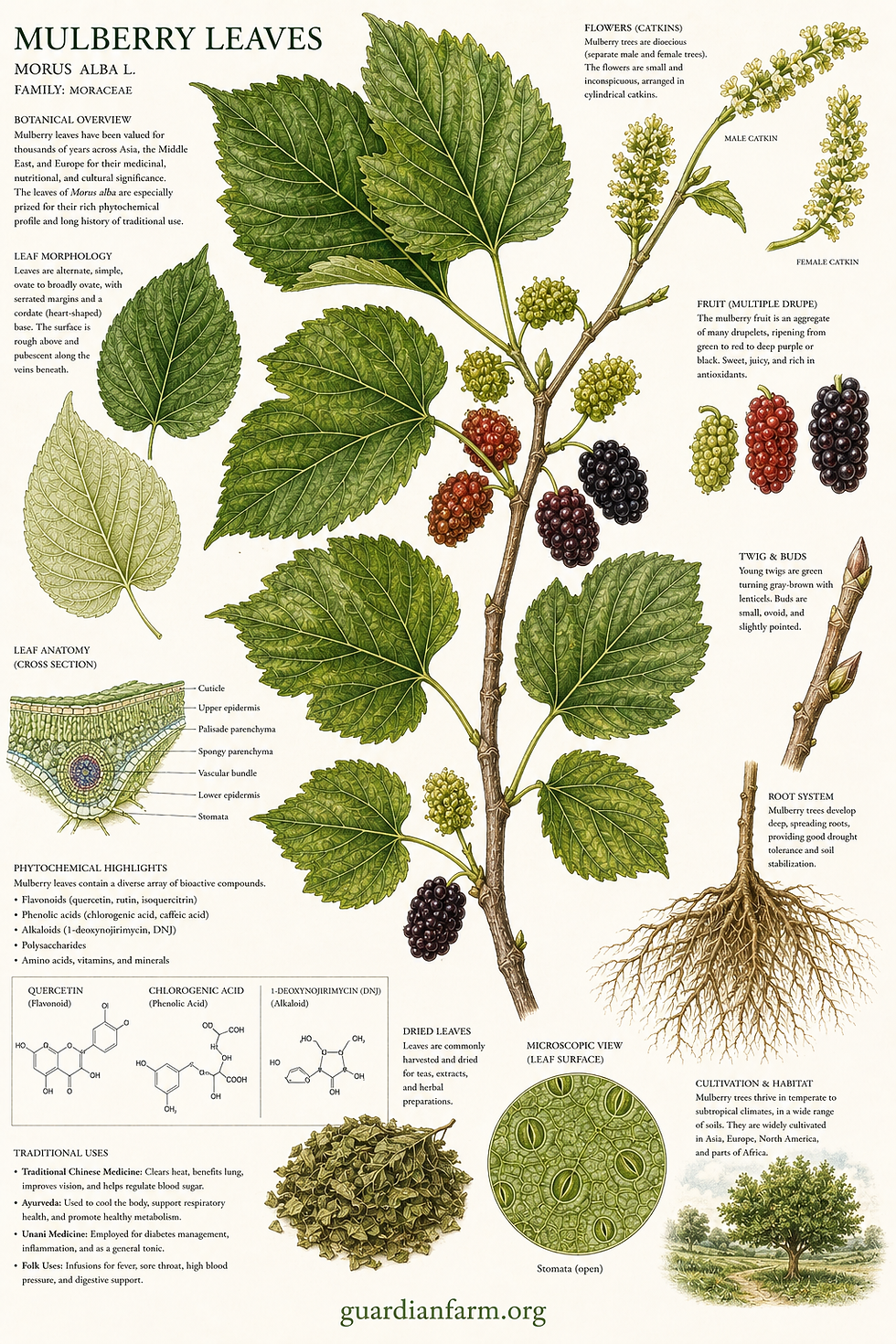
Chinese medical practitioners have used several parts of the mulberry plant for centuries to treat various health conditions. The Chinese term for the mulberry plant is sang. The plant parts used in Chinese herbology include the fruit (sang shen), leaves (sang ye), and the root bark (sang bai pi). Additionally the silkworm fecal matter (can sha) created after the worms have eaten the leaves is an important medicinal derived from this plant. Each plant part has unique characteristics and different therapeutic use.
The meridians addressed by sang ye — the mulberry leaf — are the liver and lung. Its key actions are to clear external heat, address colds and flu, fever, headaches, and vomiting blood.
In Traditional Chinese Medicine, leaves of Morus alba possess sweet, slightly bitter, and slightly cold properties, and their primary uses are described as "to expel wind and heat from the lungs, as well as to clear the liver and the eyes."
This description — clear the liver, clear the eyes — is pharmacologically specific. The liver is the primary organ of metabolic regulation in TCM, and "clearing" it refers to reducing heat and inflammation that manifest as elevated liver enzymes, metabolic dysfunction, and the kind of systemic inflammation that underlies chronic disease. The eyes are connected to the liver meridian in TCM, and conditions like diabetic retinopathy — which we now understand as a complication of chronically elevated blood sugar — would, in this framework, be a liver-related condition. The mulberry leaf's effect on blood sugar regulation, confirmed by modern clinical trials, is exactly what "clearing the liver" meant in classical Chinese medicine.
Documented usage of Morus alba dates back to the Han Dynasty, around 200 BCE, where Chinese pharmacopeias like Shennong Bencao Jing cited its "slightly sweet, cool" nature. In Ayurveda, texts such as the Chakradatta (circa 12th century) recommended white mulberry leaf to balance Pitta and Kapha doshas, helping to cool inflammations and support liver health. Persian and Arabic herbalists in medieval times praised it for easing coughs, soothing sore throats, and promoting hair growth.
DNJ: The Molecule That Changes Blood Sugar
The compound that has made mulberry leaves the subject of intense modern pharmacological interest is 1-deoxynojirimycin — DNJ — an iminosugar alkaloid found in significant concentrations in mulberry leaves and almost nowhere else in the natural world.
Modern pharmacological studies have revealed that mulberry leaves are rich in the alkaloid 1-deoxynojirimycin (DNJ), which is a prototypical iminosugar compound. DNJ can effectively inhibit the activity of α-glucosidase.
DNJ significantly reduced postprandial plasma glucose at 30 minutes, postprandial plasma insulin at 30 minutes, and both glucose and insulin incremental area under the curve at 120 minutes. These findings align with DNJ's role as an inhibitor of α-glucosidase and sucrase, delaying carbohydrate digestion and glucose absorption in the small intestine.
α-glucosidase inhibition is the mechanism of action of acarbose, one of the most widely prescribed pharmaceutical antidiabetic drugs in the world. Mulberry leaf contains a natural compound that does essentially the same thing — blocking the enzyme that breaks down complex carbohydrates into glucose in the small intestine, thereby flattening the postprandial blood sugar spike that is the primary driver of diabetic damage.
Preclinical studies on diabetic rodents have demonstrated that DNJ can significantly reduce blood glucose levels, lower HbA1c — a long-term marker of blood sugar control — and improve insulin sensitivity. Animal studies also indicate that DNJ's inhibition of α-glucosidase effectively delays carbohydrate digestion, reducing postprandial blood sugar spikes, a crucial factor in preventing the progression of diabetes. In human clinical trials, DNJ-containing mulberry extracts have shown similarly beneficial effects.
In traditional Chinese medicine, mulberry leaf is used to treat inflammation, colds, and antiviral illnesses. Mulberry leaves are one of the herbs with many medicinal applications, and as mulberry leaf study grows, there is mounting evidence that these leaves also have potent anti-diabetic properties.
Beyond DNJ: A Complete Pharmacological Profile
DNJ is the most studied compound in mulberry leaves, but the leaf is not a one-compound medicine. The polysaccharides in mulberry leaves also play a very important role in the improvement of blood sugar.
According to several traditional literature, Morus alba leaves, berries, branches, bark, and roots possess antioxidant properties and anti-diabetic potential in the Ayurveda medication system. All parts of the plant have been utilized in folk medicine for purgative, cooling, diuretic, laxative, brain tonic, and anthelmintic properties. In Ayurveda, decoctions of leaves are used in the treatment of gingivitis and sore throat.
The ancient Romans treated diseases of the mouth, lungs, and trachea using the leaves of the white mulberry tree. Native Americans also used mulberry fruits as laxatives and to cure dysentery. The roots were also used to eliminate tapeworms.
The anti-inflammatory properties of DNJ extend beyond blood sugar. Beyond its blood glucose-lowering properties, DNJ has shown potential as an anti-oxidant and anti-inflammatory agent. Chronic inflammation and oxidative stress are closely associated with diabetes and its complications.
Clinical Trials: The Evidence Accumulates
Mulberry leaves have been used in traditional medicine for treating hyperglycemia. A randomized controlled study examined the optimal dose of DNJ in mulberry leaves and the efficacy and safety of mulberry leaves in glycemic control in obese persons with borderline diabetes. Healthy adults were recruited into the dose-finding study and randomly allocated to ingest sucrose solution concurrently with mulberry leaf powder at weights equivalent to 0, 6, 12, and 18 mg of DNJ. Postprandial glucose and undesirable effects were evaluated.
A 2023 study in the Journal of Ethnopharmacology examined the multiple components in mulberry leaf that work through the PI3K/Akt insulin signaling pathway in type 2 diabetic rats — one of the most important regulatory pathways in metabolic disease — finding that the whole leaf extract outperformed isolated DNJ, consistent with the traditional whole-plant approach of Chinese medicine that has always used the complete leaf rather than isolated constituents.
An array of active components in mulberry leaf extract may provide higher potency in inhibiting intestinal glucose absorption compared to the single component DNJ alone. This is the same finding that has emerged in the research on matico, ginger, and graviola: the whole is more than the sum of its parts, and plants that have been used as whole medicines for millennia are pharmacologically wiser than the reductionist impulse to isolate single compounds.
The EU recognized this body of evidence: A large number of herbal preparations, including many food supplements, are worldwide available for diabetes treatment and easily accessible, reflecting the global adoption of mulberry leaf's anti-diabetic reputation across wherever the tree has been naturalized.
The Silk Road as Pharmacological Highway
There is an extraordinary irony in the history of the mulberry leaf. The Silk Road — the ancient trade network whose name derives from the product made possible by the mulberry leaf's relationship with the silkworm — was also a pharmacological highway along which mulberry's medicinal knowledge traveled.
Arab physicians who encountered mulberry medicine in Persia and Central Asia carried it into their own medical encyclopedias. Avicenna's Canon of Medicine references the mulberry. Persian and Arabic herbalists in medieval times praised mulberry for easing coughs, soothing sore throats, and promoting hair growth, with some 13th-century manuscripts revealing oil infusions made with mulberry root bark for scalp health.
European herbalists received this knowledge through Arabic medicine and direct contact during the Crusades. References in various old Chronicles show that the mulberry tree was far more esteemed in ancient times than at present. Mulberry was included among the large number of useful plants ordered by Charlemagne in 812 AD to be cultivated on the imperial farm. In 1608, King James I issued an edict encouraging the cultivation of mulberries to promote England's silk industry.
King James I's mulberry trees still stand in parts of England. He was wrong about the silk industry — the British climate doesn't suit silkworms — but the medicinal tradition he inadvertently imported with the trees has outlasted the commercial experiment.
The Patience of the Mulberry Tree
Mulberries do not bud until all danger of frost is past, and so they symbolize calculated patience.
This botanical trait — the mulberry tree's refusal to leaf out until it is absolutely certain winter is over, making it one of the most frost-proof trees in temperate climates — is the source of one of its oldest symbolic meanings. The tree that will not be rushed, that will not be fooled by a warm day in February, that waits with absolute confidence until the cold is truly gone, became a model of wisdom in a dozen different cultures. Japanese shrine culture associated it with self-sacrifice and steady support. Chinese poetry associated it with home, rootedness, and the long view. Greek tradition associated it — through Pan — with intelligence.
There is something in this character that feels consistent with what the leaf does medicinally: not a dramatic intervention, not a pharmaceutical spike, but a steady, patient modulation of the processes that go wrong slowly, over years — the gradual rise of blood sugar, the chronic low-level inflammation, the incremental oxidative damage that accumulates across a lifetime. The mulberry leaf addresses these processes in the same register in which they occur: slowly, steadily, over time.
Another intriguing aspect of mulberry folklore is its association with love and romance. In some European traditions, it was believed that the time it took for a mulberry tree to bear fruit — usually several years — was the ideal length of courtship before marriage. Young couples would sometimes plant a mulberry tree together, vowing to marry when it bore fruit.
Vincent Van Gogh's Mulberry
Vincent van Gogh featured the mulberry tree in several of his paintings. The most famous — The Mulberry Tree, painted in October 1889 while Van Gogh was living at the Saint-Paul-de-Mausole asylum in Saint-Rémy-de-Provence — is one of the most kinetically alive paintings of any tree in the Western canon. Its branches twist in every direction with a controlled frenzy; its golden autumn leaves vibrate against the blue sky; the whole composition is barely contained energy. Van Gogh painted it, he said, in a single session, possessed by the pleasure of it.
The painting captures something real about the mulberry tree that neither mythology nor pharmacology quite touches: its sheer vitality, its refusal to be static, the way it participates in the life of everything around it — silkworms, poets, lovers, emperors, patients with diabetes, monks in Japan performing offerings at shrines. This is a tree that has never stopped being entangled with human life.
Conclusion: The Leaf That Was Always Two Things at Once
What is extraordinary about the mulberry leaf is that it has always been simultaneously the most practical and the most mythologized leaf in the world. It was the leaf that built the silk industry and thus the global economy of the ancient world. It was also the leaf under which Pyramus and Thisbe died, the leaf that Empress Xi Ling Shi watched silkworms consume as she pulled a thread of light from a cocoon, the leaf that Chinese physicians called the immortality herb, the leaf that Van Gogh painted in the grip of something close to joy.
It has been celebrated by emperors, poets, artists, and depicted in various literary compilations. Its high source of vitamin and mineral content provides a miraculous ability to boost vitality and ensure wellness.
And it is the leaf whose compound DNJ is now in clinical trials as a natural treatment for one of the most prevalent chronic diseases of modern civilization — type 2 diabetes — doing precisely what the Shennong Bencao Jing said it did when it called it the tea of godly hermits two thousand years ago: cooling the liver, clearing the eyes, regulating the body's relationship with sweetness.
The tree that gave the world silk gives it now something else: a leaf that medicine is only beginning to understand, and that the world spent five thousand years already knowing.


Comments