
%20(1).png)


Bougainvillea / Trinitaria
Updated: May 12
Sacred Legend, Ancient Lore & Modern Science
Origins & Botanical Identity
Bougainvillea spectabilis, B. glabra, B. peruviana — the genus the world knows simply as bougainvillea is a thorny, climbing, explosively colorful member of the Nyctaginaceae family, native to the humid tropical forests of South America, with the greatest concentration of its species diversity in Brazil and Peru. It grows as a scrambling vine, a shrub, a small tree, or a low ground cover depending on environment and pruning, reaching anywhere from one to twelve meters, arming itself with sharp spines darkened with wax along its arching branches, and producing in warm months a spectacle of color so intense impossible magentas, deep purples, blazing oranges, whites of near-luminous purity — that photographers routinely find it difficult to render without appearing to have oversaturated their images. The color seems not to reflect light but to generate it.
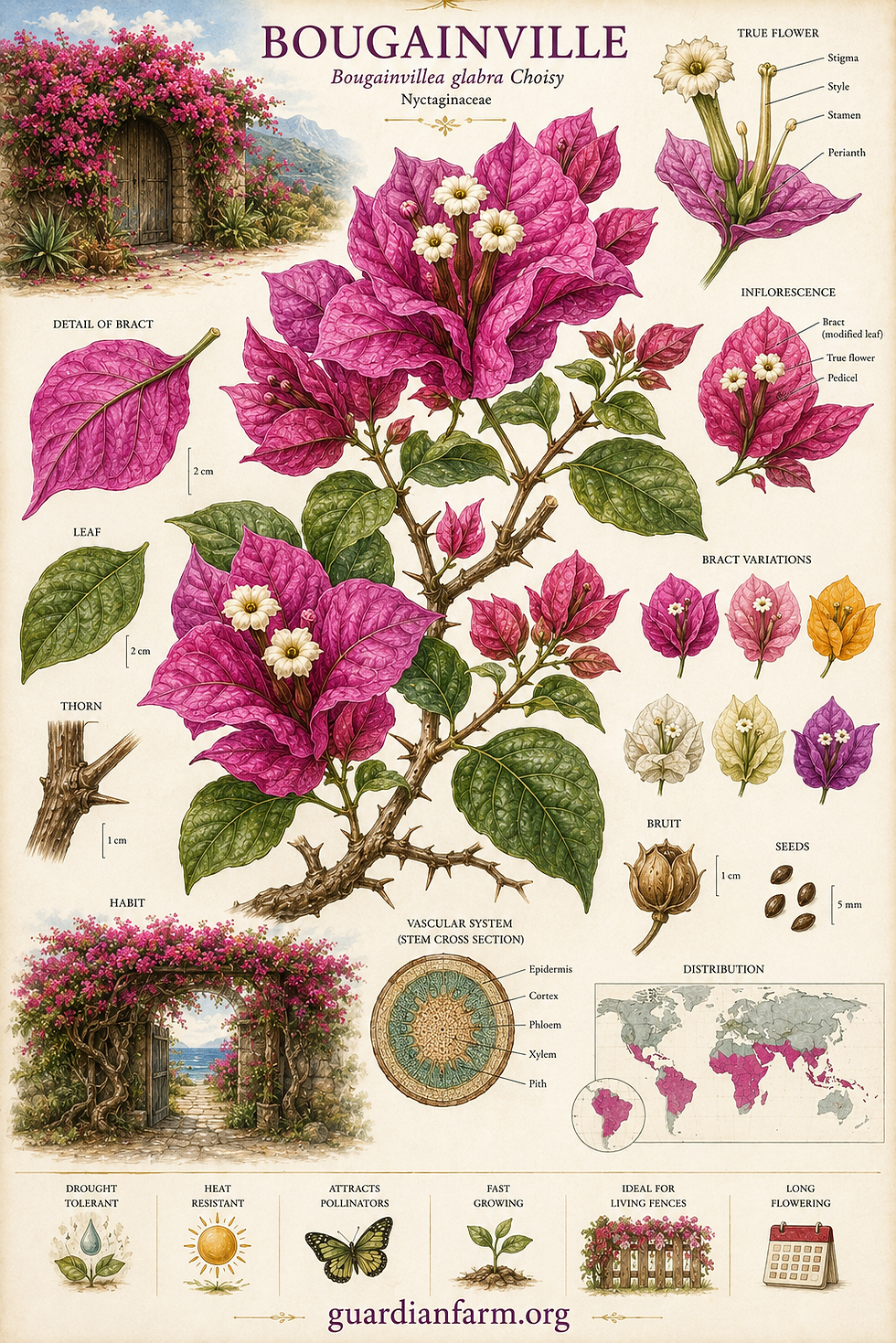
There is, however, a botanical secret at the heart of bougainvillea's beauty that matters to this story. The spectacular color is not produced by petals. What appears to be a flower those papery, brilliantly pigmented structures that cascade across garden walls and temple gates and Mediterraneans cliffs from Lisbon to Lahore is a bract, a modified leaf. The true flowers of bougainvillea are tiny, white, and tubular, tucked almost invisibly inside each cluster of three bracts, hidden inside the display as if the plant had decided that the real thing was too modest to be seen. Beauty that conceals depth. Color that is not what it appears to be. The plant encodes this lesson structurally, in its own anatomy, before any human mythology gets involved.
The name bougainvillea carries a story and, as it turns out, a hidden story within that story. The genus was named by the French botanist Antoine-Laurent de Jussieu in 1789 in honor of Louis-Antoine de Bougainville, the French naval admiral who led the first French circumnavigation of the globe between 1766 and 1769. The expedition carried a naturalist, Philibert Commerson, who collected specimens of the plant during a brief stop in Rio de Janeiro in 1767 and whose name appears in the official scientific record as its discoverer. But Commerson was frequently incapacitated by illness throughout the voyage. His assistant — listed in the ship's manifest as his male servant — was Jeanne Baret, a peasant woman, expert herbalist, and botanist who had disguised herself as a man to circumvent the French navy's absolute prohibition on women aboard naval vessels. Baret was, according to historical scholarship now widely accepted, the one who collected bougainvillea from the hills above Rio de Janeiro drawn to its red bracts, her biographer suggests, by the Doctrine of Signatures, the ancient herbalist's intuition that color and form reveal medicinal function. She was also, as it later emerged, the first woman in recorded history to circumnavigate the globe. She was never credited for bougainvillea. The plant bears an admiral's name. The woman who found it is a footnote.
In the Spanish-speaking world, bougainvillea carries names that reveal how completely each culture has made it its own. In Colombia, Nicaragua, Costa Rica, El Salvador, and Panama it is veranera the summer plant, the plant of the dry season, blooming most spectacularly when the rains retreat. In Colombia, Panama, Puerto Rico, the Dominican Republic, and Venezuela it is trinitaria the Trinity flower, named for its characteristic structure of three bracts surrounding three flowers, a botanical trinity that in Catholic cultures resonated with theological meaning. In Argentina, Bolivia, Paraguay, and Uruguay it is Santa Rita the saint of impossible causes, patron of those who have been told their situation cannot be remedied. In northern Peru it is papelillo - little paper, for the papery translucency of its bracts. In Honduras it is napoleón. In Brazil it is primavera — spring. In Germany it is Drillingsblume — the triplet flower. In the Arab world it is jahanamiya. In Guam, where it is the official territorial flower, it is puti tai nobiu — a phrase that translates, memorably, as "it hurts to have no boyfriend."
Each name is a different civilization's encounter with the same plant — and a different recognition of something in it that mattered.
A History Rooted
The official record of bougainvillea's "discovery" dates to 1767 and a hillside in Rio de Janeiro. But this is the European record. The plant had been growing, and being used, by the indigenous communities of South America for centuries.
The people of the Amazon basin and the surrounding regions — the communities that Jeanne Baret, drawing on her herbalist's knowledge, approached with questions about the red-bracted vines she encountered — already understood the plant's medicinal properties. They used its flowers and bracts in preparations for respiratory conditions, its leaves for gastrointestinal complaints, its bark for pain and inflammation. This knowledge is not recorded in the scientific literature with dates and authors' names because it was not created for the scientific literature. It was created for the people who needed it, passed through generations of observation and practice, encoded in the practical knowledge of communities that had been living alongside this plant for as long as they had been living in South America.
When Commerson and Baret described the plant for science, and when nurseries in France and Britain subsequently propagated and distributed it throughout the colonial world — to Australia, India, the Mediterranean, the Caribbean, South Africa, Southeast Asia — they were carrying a Brazilian plant into new ecosystems, where it adapted with the remarkable vigour that makes bougainvillea, in some regions, an invasive species of near-unstoppable vitality. In Australia it is called the survivor plant, having repeatedly regenerated after bushfires reduced it to apparent ash. In coastal regions it tolerates salt winds that destroy most garden plants. In drought it blooms more intensely, as if adversity concentrates its color. In each new place it arrived, local communities encountered its color, its thorns, its tenacity, and its uses, and incorporated it into their own botanical vocabularies.
By the mid-nineteenth century, Kew Gardens was distributing bougainvillea throughout the British Empire. Natural hybrids — the first identified in Cartagena, Colombia, initially thought to be a distinct species and named B. buttiana for the European who found it — were discovered to be occurring spontaneously all over the world, as the plant's promiscuous hybridization produced new color forms in every garden where multiple species grew in proximity. Today there are over 300 named cultivars, spanning every color except blue, each one a testament to the plant's extraordinary genetic flexibility.
Sacred Legends: The Color That Crosses Thresholds
No plant in tropical and subtropical horticulture has been more thoroughly absorbed into the spiritual and symbolic life of the cultures that grow it than bougainvillea. This absorption has happened rapidly — the plant has only been in most of these cultures for two to three centuries — but with an intensity that suggests something in the plant's nature speaks directly to something in human religious imagination.
In Latin America, bougainvillea planted at the entrance of a home is understood as a spiritual threshold marker — its thorned branches not merely decorative but actively protective, believed to keep negative energy and evil spirits from crossing into the domestic space. This is a function analogous to the protective thorned plants in many older traditions: the hawthorn at the Celtic threshold, the acacia at the Egyptian sacred precinct. The thorns are understood as armor; the flowers as welcome; together they mark the boundary between the outer world and the sanctified interior.
The name trinitaria — the Trinity flower — carries its religious meaning in its structure. Three bracts, three flowers, the number that in Christian theology represents the divine unity of Father, Son, and Holy Spirit. In the Catholic communities of Colombia, Panama, Puerto Rico, and Venezuela, the plant's association with the Trinity made it appropriate for churches, for altars, for the devotional gardens maintained by communities for whom the cultivation of beauty was itself a form of prayer. To tend bougainvillea was to tend something that bore a sacred number in its very anatomy.
In India, where bougainvillea arrived through British colonial distribution and has since become a beloved fixture of subtropical landscapes from Delhi to Chennai, the plant has been associated with the goddess Saraswati — deity of knowledge, music, the creative arts, and the spoken word. The association draws on the plant's exuberant, colorful, expansive nature, which resonates with Saraswati's association with creative abundance. Bougainvillea appears in temple gardens and at the boundaries of sacred spaces, where its year-round color in tropical climates is understood as continuous devotion — the plant that never stops offering.
In Feng Shui practice, particularly in Chinese communities across Southeast Asia where bougainvillea has been widely cultivated since the early twentieth century, the purple variety is believed to attract financial abundance and is traditionally placed in the southeast corner of a garden to activate the wealth energy of that directional sector. The plant's vigorous, expansive growth — its tendency to cover walls, to fill empty spaces, to bloom in profusion — maps naturally onto the energetic language of abundance and prosperity.
In South America, bougainvillea is deeply associated with the concept of twin flames — the spiritual legend of two souls that have recognized each other across multiple lives and seek reunion through each successive incarnation. The plant's characteristic growth pattern — two or more vines intertwining as they climb, their colors sometimes distinct, their stems inseparable once established — provides an irresistible botanical metaphor for souls that grow together toward the light, cannot be separated without damage to both, and produce in their union a beauty neither could achieve alone.
The Victorian language of flowers assigned bougainvillea the meaning of passion — specifically, the gift of a bougainvillea stem to a beloved was understood as an invitation to ignite passion within the relationship. This meaning was not invented by the Victorians; it was recognized by them, from a plant whose chromatic intensity — those impossible magentas, those burning magentas — had been speaking the language of desire since it cascaded down the hillsides above Rio de Janeiro before anyone with European botanical training had arrived to name it.
What the Traditional Healers Knew
Long before any phytochemist isolated pinitol or characterized bougainvinones, healers across South America, Mexico, the Caribbean, Africa, India, and Southeast Asia had assembled a remarkably consistent picture of what bougainvillea could do, building from independent observation in very different disease environments to convergent therapeutic conclusions.
The most universal of these conclusions concerns the respiratory system. Across Mexico, Brazil, the Caribbean, and traditional communities in India, bougainvillea flowers and bracts prepared as infusions or syrups have been the primary botanical intervention for coughs, bronchitis, asthma, sore throat, and flu. The infusion is prepared by steeping dried or fresh bracts and flowers in hot water — often with honey, lemon, or ginger added not merely for flavor but for their own complementary therapeutic properties — and drunk warm to soothe throat irritation, reduce airway inflammation, and promote expectoration. In Mexico, this preparation has been used in rural communities for generations and has given rise to commercial bougainvillea-based syrups for respiratory tract discomfort that remain available in Mexican markets today.
In the Kolli Hills of Tamil Nadu, India, B. spectabilis is used by traditional practitioners specifically for inflammation — its anti-inflammatory application having been developed independently from the South American tradition, suggesting that the plant's properties were apparent enough to be recognized by any community that paid attention to what happened when people used it. In Mandsaur, India, the leaves are prepared for gastrointestinal disorders including diarrhea and acidity. In Africa, extracts of B. glabra are used to improve intestinal disorders. In the Ayurvedic tradition, the plant appears as a kapha-reducing, anti-inflammatory agent, particularly relevant for conditions of the respiratory tract where excess mucus and inflammation are the presenting features — precisely the conditions for which communities on three other continents have independently reached for the same plant.
In Mexico, bougainvillea infusions have been prepared for fevers, as antimicrobial agents for skin conditions including acne and minor wounds, and as preparations for managing blood sugar in diabetic patients — a use that, as modern research has confirmed, is grounded in the plant's actual chemistry rather than in wishful thinking.
The traditional preparation varies by region but follows a consistent logic: the bracts and flowers are the primary medicinal parts, whether consumed as infusion or applied as poultice. The leaves are used for gastrointestinal and topical applications. The stem bark contains a separate and pharmacologically distinct set of compounds — the bougainvinones — that have attracted scientific interest for their cytotoxic properties. Traditional healers working with the whole plant over centuries arrived at an informal differentiation between its parts that modern phytochemistry has since confirmed.
What the Plant Actually Is
A clarification that botanically matters and aesthetically deepens the story: what appears to be bougainvillea's flower is not a flower. The vivid colored structures — the bracts — are modified leaves, analogous to the red "petals" of a poinsettia or the white surrounding structure of a calla lily. Inside each cluster of three bracts are the true flowers: tiny, tubular, usually white or cream, often unnoticed unless one looks specifically for them.
The plant is a member of Nyctaginaceae — the four-o'clock family, named for the genus Mirabilis, which opens its flowers in the late afternoon. Within this family, bougainvillea occupies a unique niche: it is the genus that has turned bract coloration into one of the most spectacular chromatic displays in the plant kingdom, producing the pigments responsible for its colors through the betalain pathway — a pigment chemistry found in only ten plant families on earth, shared with beetroot, amaranth, and cactus fruits, and responsible for some of the most vivid reds, purples, and oranges in the plant world.
The genus contains between 14 and 18 recognized species, depending on taxonomic authority, with the most medicinally and horticulturally significant being B. spectabilis (the great bougainvillea of South American origin), B. glabra (the smooth bougainvillea, sometimes called paper flower for the particular translucency of its bracts), and B. peruviana (the Peruvian bougainvillea, source of many hybrid crosses). The natural hybrid B. x buttiana — first identified in Cartagena — produced many of the most intensely colored cultivars now grown worldwide.
The plant grows in full sun, tolerates drought, salt wind, and poor soil with equanimity, and actually blooms more profusely under mild stress — a counterintuitive relationship between difficulty and beauty that has made it the signature plant of the Mediterranean, the California coast, the Indian subcontinent's cities, and the tropical Americas. It has been described, not entirely metaphorically, as a plant that thrives on adversity.
The Chemistry: Betalains, Pinitol, and Bougainvinones
The therapeutic power of bougainvillea arises from an unusually diverse array of bioactive compounds concentrated in different parts of the plant, making it — like several other plants in this series — a multi-system botanical rather than a single-target medicine.
The bracts and flowers that provide the color also provide the primary medicinal compounds for respiratory and anti-inflammatory applications: o-dihydrophenols, anthocyanins, lignin, and proline, which together produce significant inhibition of both acute and chronic inflammatory pathways. The betalains — the pigment compounds responsible for bougainvillea's characteristic colors — are among the most potent antioxidants found in any plant material, with demonstrated ability to neutralize free radicals and reduce oxidative stress in cell membranes. This antioxidant activity is not incidental to the plant's color; it is continuous with it. The same pigment compounds that make bougainvillea impossible to ignore are the compounds that protect its cells from oxidative damage — and, when consumed, protect human cells by the same mechanism.
D-pinitol — a naturally occurring cyclitol found in meaningful concentrations in bougainvillea leaves — functions as an insulin sensitizer, improving the cellular uptake of glucose through mechanisms that overlap with those of pharmaceutical antidiabetic drugs. Known from pine trees and legumes since the early twentieth century, pinitol's presence in bougainvillea has been confirmed and its antidiabetic activity in the plant specifically investigated across multiple studies, positioning bougainvillea among the richer dietary sources of this compound.
The stem bark of B. spectabilis contains a class of compounds called bougainvinones — specifically, bougainvinones A through H — peltogynoid compounds that have shown significant cytotoxic activity against multiple cancer cell lines. These compounds are structurally distinct from both the pigment compounds of the bracts and the pinitol of the leaves, representing a pharmacologically separate dimension of the plant's chemistry.
The plant also contains quercetin, quercetagetin, kaempferol, and other flavonoids with anti-inflammatory and antioxidant activity; terpenoids with immunomodulatory properties; alkaloids; tannins; saponins; and phenolic acids. It is, in the terminology now familiar in this series, not a one-compound plant. It is an orchestra.
Anti-Inflammatory Action: The Science Behind the Color
The anti-inflammatory properties of bougainvillea that traditional practitioners in Tamil Nadu, Mexico, Brazil, and India observed independently have been confirmed in laboratory and animal studies with a consistency that makes the convergent traditional wisdom look less like coincidence and more like accurate observation.
Bougainvillea spectabilis extracts have demonstrated significant inhibition of both acute and chronic inflammation in experimental models, attributed primarily to the o-dihydrophenols and betalain pigments concentrated in the bracts. The mechanism involves the same core inflammatory pathways — prostaglandin synthesis, cytokine production, NF-κB activation — that pharmaceutical anti-inflammatory drugs target, but through a combination of compounds acting simultaneously on multiple points in the cascade rather than the single-target approach of most pharmaceuticals.
Reviews published in both Frontiers in Chemistry and Evidence-Based Complementary and Alternative Medicine have confirmed that bougainvillea extracts demonstrate multiple pharmacological activities including anti-inflammatory, antioxidant, immunomodulatory, antimicrobial, antidiabetic, and anticancer effects — a breadth that traditional practitioners understood empirically and that scientists are now mapping at the molecular level.
The respiratory applications of traditional bougainvillea medicine rest on this anti-inflammatory foundation: the infusions reduce airway inflammation, the expectorant properties help clear congested mucus, and the antimicrobial activity addresses the bacterial component of conditions like bronchitis that involve both inflammation and infection. The traditional combination of bougainvillea flowers with ginger, honey, and lemon — common across Mexican, Caribbean, and Indian folk preparations — compounds these effects: ginger adds further anti-inflammatory action through gingerols; honey provides antimicrobial activity and coats inflamed mucosa; lemon adds vitamin C and enhances absorption of the flower's flavonoids.
Scientific Studies: The Antidiabetic Dimension
The most extensively researched pharmacological property of bougainvillea — and the one that has produced the most clinically significant findings — is its antidiabetic activity, centered on the compound D-pinitol.
D-pinitol is a cyclitol — a cyclic sugar alcohol — that functions in the body as an insulin mimetic, improving insulin sensitivity and promoting cellular glucose uptake through mechanisms that partially overlap with those of metformin, the world's most widely prescribed antidiabetic drug. Research has shown that pinitol activates components of the insulin signaling pathway that are impaired in type 2 diabetes, effectively improving the cell's ability to respond to its own insulin signal without requiring the pancreas to produce more of it.
A 2023 study published in Pharmaceuticals evaluated five cultivars of Bougainvillea spectabilis for their D-pinitol content and antidiabetic activity in streptozotocin-induced diabetic rats over one month of daily oral treatment. All five cultivars demonstrated significant improvements in blood glucose levels, oxidative stress markers, inflammatory cytokines, lipid profiles, liver enzymes, and renal function markers. The orange-bracted cultivar — which contained the highest D-pinitol concentration — demonstrated antidiabetic efficacy exceeding that of glibenclamide, a standard pharmaceutical antidiabetic medication. This finding positions bougainvillea not merely as a folk remedy with plausible theoretical mechanisms but as a plant whose active principle, in appropriate concentrations, surpasses a pharmaceutical comparator on multiple metabolic parameters simultaneously.
The isolation of the antidiabetic principle of B. spectabilis stem bark has been separately confirmed, suggesting that pinitol is distributed across multiple plant parts, with leaves and bark both providing accessible sources for traditional preparations.
Scientific Studies: Cancer Research and the Bougainvinones
The anticancer properties of bougainvillea stem bark compounds represent one of the most promising and least widely known findings in recent botanical pharmacology. The peltogynoid compounds bougainvinones A through H, isolated from the stem bark of B. spectabilis, have demonstrated significant cytotoxicity against multiple human cancer cell lines in vitro.
Studies published in peer-reviewed pharmacological literature have shown that bougainvinones exert cytotoxic activity against KB cells, HeLa S-3, HT-29 (colon cancer), HepG2 (liver cancer), and MCF-7 (breast cancer) cell lines, with IC50 values in the range of 6 to 9.7 micromolar for most compounds — concentrations within the range considered pharmacologically meaningful for anticancer lead compounds. Bougainvinones B and C showed the highest cytotoxicity of the series.
Separately, bougainvillea flower extract mediated zinc oxide nanomaterials have demonstrated both antimicrobial and anticancer activity, suggesting that the plant's compounds can function as reducing agents in nanoparticle synthesis with retained biological activity — an emerging application in nanomedicine that uses plant extracts as green synthesis platforms for therapeutic nanoparticles.
The crude extract of bougainvillea has also shown selective cytotoxicity, cell cycle arrest, and apoptosis induction in cancer cell studies consistent with its high phenolic and flavonoid content. These findings are in early stages and have not yet advanced to human clinical trials — the same limitation that attends much of the most interesting botanical anticancer research. The trajectory, however, across multiple cell line studies and multiple research groups, is consistent enough that bougainvillea is increasingly regarded as a source of pharmacologically significant anticancer lead compounds worth systematic investigation.
The Antimicrobial Dimension
Bougainvillea's traditional use as an antimicrobial — for wound healing, skin infections, respiratory infections, and gastrointestinal pathogens — has been confirmed in laboratory studies against a range of clinically significant organisms.
Extracts of B. glabra have demonstrated antibacterial activity against organisms responsible for respiratory tract infections, gastrointestinal diseases, and skin conditions. The antimicrobial compounds in the bracts and flowers include the betalains, phenolic compounds, tannins, and alkaloids that together create a multi-compound antimicrobial profile that acts at multiple bacterial targets simultaneously — a characteristic of plant antimicrobials that may explain why bacterial resistance to plant extracts develops more slowly than resistance to single-molecule pharmaceutical antibiotics.
The antidiarrheal activity of bougainvillea observed in traditional African and Indian use has been confirmed to relate at least partially to this antimicrobial property — reducing the bacterial load in the gastrointestinal tract — as well as to astringent tannin activity that reduces intestinal fluid secretion and slows motility.
Bougainvillea in Gardens, Kitchens, and Medicine Cabinets
In Mexico, bougainvillea is the plant that cascades over the walls of every colonial courtyard, every market, every hacienda, every churchyard from Oaxaca to Guadalajara. It is so ubiquitous that it has become invisible — seen without being noticed, present without being remarked upon. Yet the grandmother who clips a handful of bracts and flowers and steeps them for a child with a cough is reaching for something her own grandmother taught her, in a chain of knowledge that connects the contemporary Mexican kitchen to the indigenous communities of South America who were already using this plant before European ships arrived.
In India, bougainvillea tumbles over compound walls in every subtropical city, planted not only for its beauty but for the practical protection its thorns provide and for the temple association its color carries. The commercial bougainvillea-based respiratory syrups sold in Indian ayurvedic pharmacies are a formal elaboration of the same traditional knowledge that has been applied informally in home remedies for generations.
In the Caribbean — where trinitaria arrives at Christmas tables in Trinidad alongside sorrel (Hibiscus sabdariffa, the flor de jamaica of this series' previous chapter) — the plant's festive connotations have somewhat obscured its medicinal identity. But in rural communities the knowledge persists: the flowers for the chest, the leaves for the stomach, the infusion drunk warm with honey.
The bracts are edible, and in the contemporary food world they appear in salads and desserts as natural colorants, producing a delicate floral note and a pale blush pink when used as a food dye. The betalain pigments they contain are water-soluble, heat-stable, and — unlike synthetic food colorants — come with documented antioxidant activity as part of the package.
A Caution Written in Thorns
For all its beauty and its medicinal promise, bougainvillea asks to be approached with appropriate care. The sap of Bougainvillea species can cause serious skin rashes in sensitive individuals, analogous in mechanism to the dermatitis caused by poison ivy — an allergic reaction to compounds in the plant's latex that develops on repeated contact and can become severe. Gardeners who work frequently with the plant without gloves are the most commonly affected.
The thorns themselves are coated in a dark waxy substance that can cause infection if they puncture skin — not because the wax is toxic but because it carries environmental bacteria into the wound. The thorns are not to be dismissed as merely inconvenient; they are the plant's defense, honed by evolution to be effective, and they require the same respect as the thorns of any seriously armed plant.
The safety of bougainvillea preparations during pregnancy and lactation has not been established, and the plant's traditional use as an abortifacient in some communities — a use attributed primarily to the stem bark preparations — means that pregnant women should avoid consuming any bougainvillea preparations beyond the most dilute culinary uses.
As with all plants in this series, the distinction between traditional food-medicine use — a moderate ongoing infusion of flowers and bracts — and high-dose concentrated extracts is one that matters both in terms of efficacy and safety. The plant's traditional preparations were calibrated by generations of use. Concentrated extracts, while pharmacologically interesting, have not been validated for human use at clinical scale.
Conclusion
Bougainvillea is one of those plants that is simultaneously everywhere and nowhere — so familiar in warm climates that it becomes part of the visual background of life, so ubiquitous that its presence requires no comment, so consistently encountered on walls and gates and temple boundaries that the eye moves past it without stopping. And yet, when you stop, when you look at what the plant actually is — at the extraordinary chemistry concealed behind those colors that seem to emit rather than reflect light, at the medicinal knowledge carried quietly in its flowers and leaves across South America, Mexico, India, the Caribbean, and Africa, at the story of the woman who found it first and was never credited, at the theological meaning encoded in its three-bracts-three-flowers structure — you find a plant of unexpected depth.
The color that is not petals. The flower that is hidden inside the display. The discovery credited to a man when it was made by a woman. The ornamental plant that is also, quietly, a medicine. Bougainvillea seems constitutionally opposed to being only what it appears to be.
In Brazil it is primavera — spring, perpetual renewal. In Venezuela and Panama it is trinitaria — the Trinity, the sacred three. In Argentina it is Santa Rita — the patron of impossible causes. In Peru it is papelillo — little paper, delicate and transient. In Guam it is a statement about longing. In Tamil Nadu it is a preparation for inflamed airways. In the gardens of Mexican grandmothers it is a remedy for children's coughs. In the stem bark laboratories of Al-Azhar University it is a source of compounds that kill cancer cells in petri dishes, waiting for the next stage of research to tell us what they might do in human bodies.
Whether it is called veranera climbing the walls of a Colombian courtyard, bugambilia flowering outside a Mexican church, trinitaria at a Caribbean Christmas table, or simply bougainvillea on a terrace overlooking the Mediterranean — it is the same extraordinary plant, offering the same lesson it encodes in its very anatomy: what appears to be the flower is not the flower. The real thing is hidden inside the display, quiet and white and waiting to be found by those who look carefully enough.
Jeanne Baret looked carefully enough. She found the plant. The plant deserved better recognition than history gave it. So did she.


Comments